How to Build Good Habits: A Field Guide

A Letter From Your Future Self
G’day Past Me,
I’m writing to you from the future where you have this all sorted. You wake at 5am sharp. You journal. You meditate. Your skin is clear and your inbox is at zero.
Just pulling your leg. I’m writing from next Tuesday.
We didn’t do any of that. But we did buy a very nice journal. It’s got a textured cover.
Yours in solidarity, Future You
The Habit Application Process
What most people don’t realise is that learning how to build good habits isn’t just a personal decision—it’s a formal application to the Ministry of Internal Affairs, a bureaucratic body that has existed since the invention of guilt.
Recent Rejections:
Application: “I would like to wake up at 6am.” Status: UNDER REVIEW Reason: Applicant’s sleep schedule data (2010–Present) suggests this request is statistically improbable. Please provide proof of identity.
Application: “I will go to the gym five days a week.” Status: ADMINISTRATIVE ERROR Note: Duplicate application detected. See files: January 2018, January 2019, January 2020. Process suspended pending realistic goal setting.
Skip the jokes, just tell me what actually works
A Note on the Multiverse
somewhere in another timeline, there is a version of you who has perfected the art of the routine.
They wake at 5am without hitting snooze. They journal for exactly 15 minutes. They never doom-scroll. They describe their morning routine at dinner parties, completely unprompted.
To be fair, that version of you is a bit exhausting and everyone secretly hopes they don’t get sat next to them.
You, on the other hand? You’re good value. You’ve made choices. Different choices, sure, but you’re fun to be around.
Field Study: The “All The Gear” Syndrome
From the research notes of Dr. Bartholomew J. Fictitious, Institute of Wishful Thinking
The Habit Enthusiast (Homo Resolutionus) is most commonly observed in two natural environments:
- The first week of January
- Late Sunday evenings
During these periods, the Enthusiast experiences what we call “Optimistic Purchasing Behaviour”—buying journals, apps, yoga mats, and books on how to build good habits, in preparation for a transformation that is definitely, 100% happening this time.
Habitat Observations:
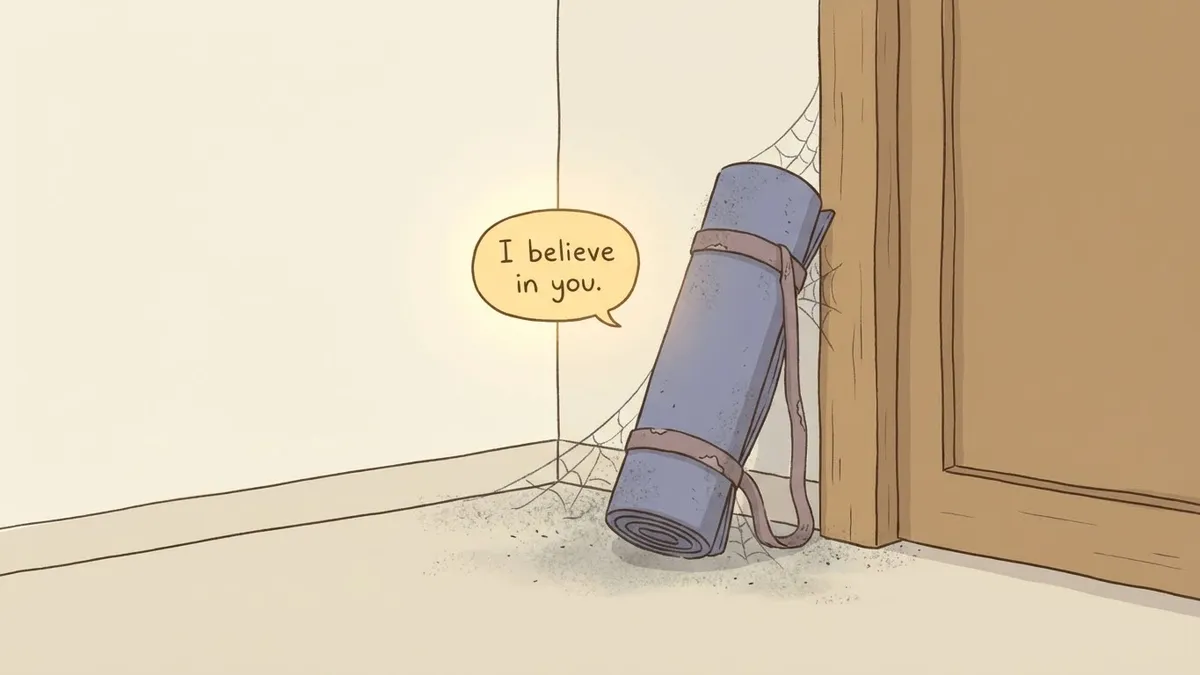
We observe the unused yoga mat in its natural position: rolled up behind the door, covered in a thin layer of hope. It has been there since March. The mat does not judge. The mat believes in you. The mat is patient.
Nearby, we note the habit-tracking journal, opened with great ceremony on January 3rd, last written in on January 7th. The handwriting on the first page is calligraphy-quality. By the last entry, it has devolved into a single, frantic word: “tired.”
Skip the jokes, just tell me what actually works
The App Graveyard
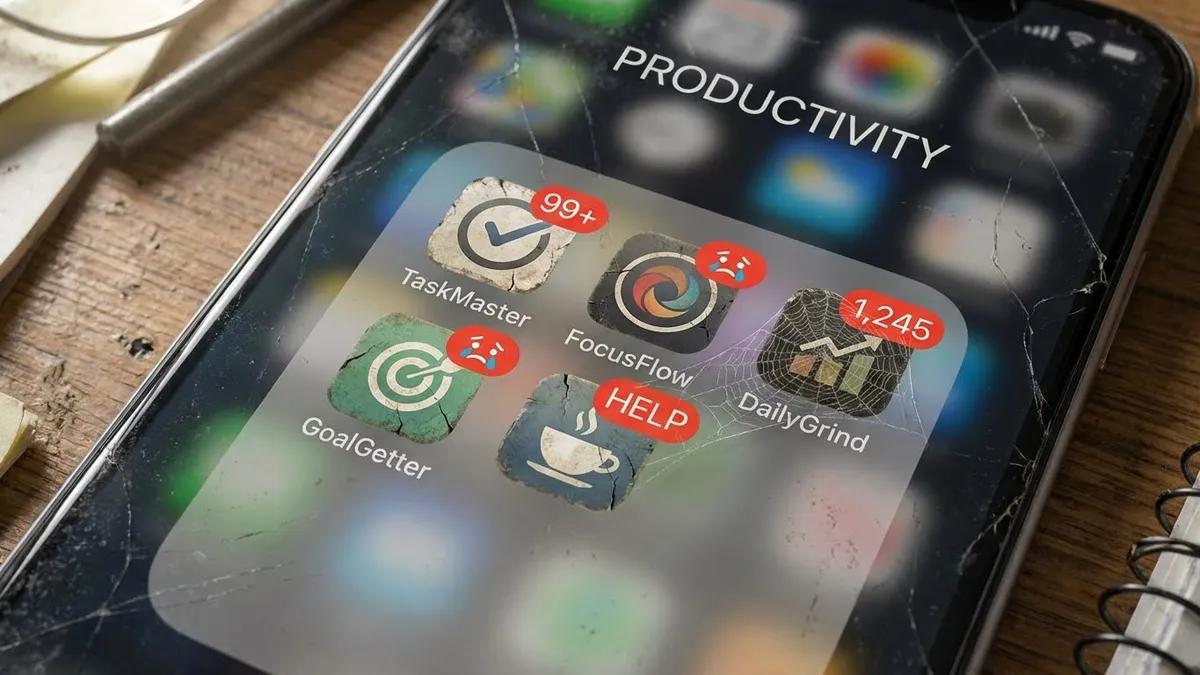
Somewhere on your phone—likely page three, tucked away in a folder you ignore—is a digital monument to good intentions.
This folder contains:
- Three meditation apps (two of which are “definitely different”)
- A water-tracking app that sends passive-aggressive notifications
- Four habit trackers, all abandoned at the two-week mark
- That one app you don’t remember downloading
- An app called “FOCUS MODE” that you have never opened
You tell six people about your new habit system. Seven, if you count the LinkedIn post.
“It’s really changed my workflow,” you explain to a colleague who just asked if you wanted a coffee.
The Habit Economy
A 2024 study from the University of Wherever You Like (Department of Plausible Statistics) found that the habit-tracking industry generates $4.2 billion annually.
Approximately $4.1 billion of this comes from people who track habits for exactly one week.
“This is expected behaviour,” explains Dr. Helena Totally-Fictional, Chair of Aspirational Purchasing Studies. “We call it ‘Optimistic App Acquisition.’ The subject genuinely believes the download button is the solution. It isn’t. But for a moment, they feel productive.”
What Actually Works (The Boring Truth)
Look, we’ve had a laugh. But you clicked this because you want to know how to build good habits that stick. Here is the boring, evidence-based advice that actually works:
1. Pick One Thing.
Not five. One. Your brain is not designed to overhaul your entire existence on a Tuesday.
2. Make it Embarrassingly Small.
One push-up. One sentence. One minute of silence. If it feels too easy, you’re doing it right. You want to lower the bar so much you can’t help but trip over it.
3. The “Hook” Method (Habit Stacking).
Attach the new thing to an old thing.
- “After I brush my teeth, I will floss one tooth.”
- “After I put the kettle on for a cuppa, I will do three squats.”
4. Expect Zero Excitement.
Real habits don’t feel inspiring. They feel automatic. They feel like nothing. That’s the point. You want to get to a stage where it feels weird not to do it.
5. Consistency Over Intensity.
Your brain likes patterns. Give it one. Showing up for two minutes is infinitely better than planning an hour-long session that never happens.
Alternatives That Might Suit You Better
Not everyone is a morning person, and that’s fine.
- Evening routines: Some people work better at night. Journaling before bed works just as well as journaling at 5am, and you don’t have to wake up at 5am.
- Trigger-based: Forget the clock. “After I get home” is often easier to stick to than “at 5:30pm sharp.”
- The “Good Enough” Rule: Aim for a B-minus. Perfection is the enemy of done.
Resources That Are Actually Useful
If you want the science behind why habits work (and why yours keep failing), James Clear’s Atomic Habits is the gold standard. It’s practical and lacks the usual fluff.
Atomic Habits: An Easy & Proven Way to Build Good Habits & Break Bad Ones

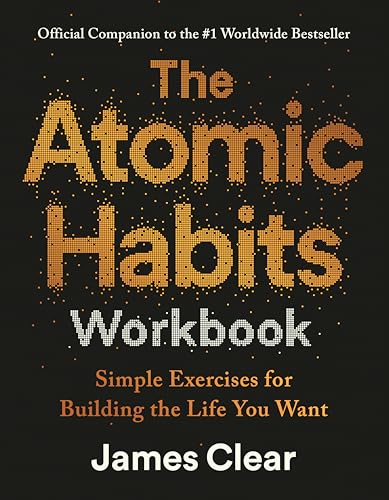
There is now a companion journal for it, which is handy if you like keeping things structured.
The Atomic Habits Workbook: Official Companion to the #1 Worldwide Bestseller
For the psychology of why we do what we do (even when we don’t want to), The Power of Habit by Charles Duhigg explains the neurological loops.
The Power of Habit: Why We Do What We Do in Life and Business

And if you want a tracker that is physical (harder to forget exists on page 3 of your phone), this simple one gets the job done:
Simple Habit Tracker Journal on Amazon
Lamare Habit Tracker Calendar – Premium Daily Habit Tracker Journal and Goal Board, Workout Motivation & Productivity Tool

As an Amazon Associate, we earn from qualifying purchases. This means that if you purchase a product through one of our links, we may receive a small commission at no extra cost to you.
In Conclusion
Somewhere in the multiverse, there is a version of you with perfect habits.
Here in this timeline, there is a version of you who read an article, had a chuckle at the yoga mat, and maybe—just maybe—will try one small thing today.
That’s enough. Good onya for having a go. The mat will wait.
The author’s yoga mat is behind the door. It has been there since March. The mat remains hopeful.